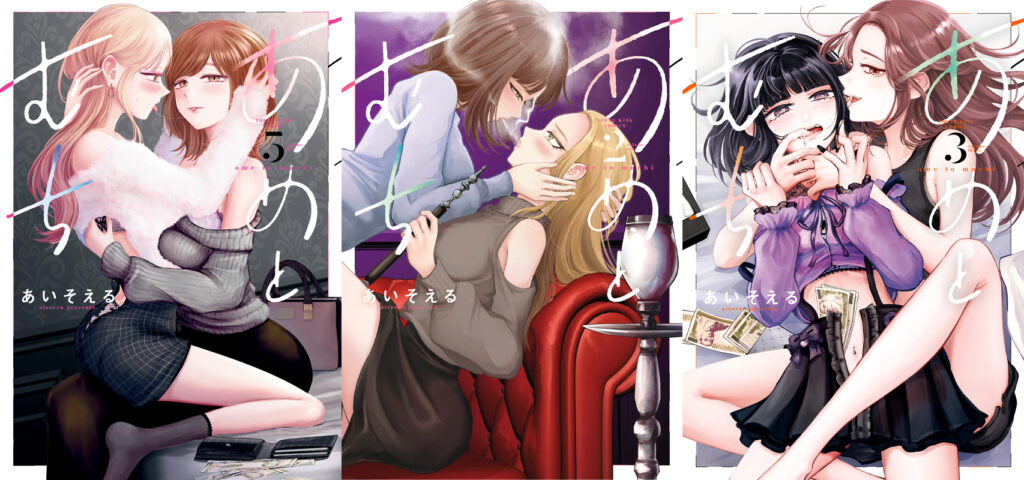
How have I only made four posts in this series? This was supposed to be something I could regularly put out without much effort. I guess part of it is that I’ve been so absorbed in studying Japanese that I haven’t been engaging with media in English much lately. So I guess it’s time talk about a Japanese manga that I read in Japanese. Japan. It’s pretty, cool right? Did you know I’m studying Japanese? It’s very commendable, I know. I’ll wait for your applause and start talking about Ame to Muchi in the meantime. As a heads up, this manga contains potentially upsetting depictions of: prostitution, homosexual and heterosexual dubcon, physical, mental, and sexual abuse, eating disorders, suicidal ideology, intentional overdosing, and stalking.
Ame to Muchi (literally “Candy and Whip”) is a manga by Aisoeru, published monthly in Young King magazine. The elevator pitch for the series would be “compensated dating yuri ero-manga,” but alongside the Hot Age Gap Lesbian Sex is an unexpectedly thoughtful exploration of the mental state of young girls stuck in the sex industry. If this sounds like a precarious balance: it is! That’s what makes this series equal parts compelling and distressing to read.
The series centers around Meari, a young woman who I will now refer to exclusively as Mary, because “Meari” is unpleasant to look at and is also the transliteration of “Mary” into Japanese. It’s a controversial choice, I know. Mary makes a living through compensated dating. Although compensated dating in Japan frequently includes sex, she refuses this lifestyle, restricting her dates to sharing a meal or going shopping. Mary is delighting in her easy income when her next date shows up, who turns out to be woman! If I hadn’t already done one pointless aside earlier in this paragraph, I’d pause here to say: A woman! In a yuri manga!
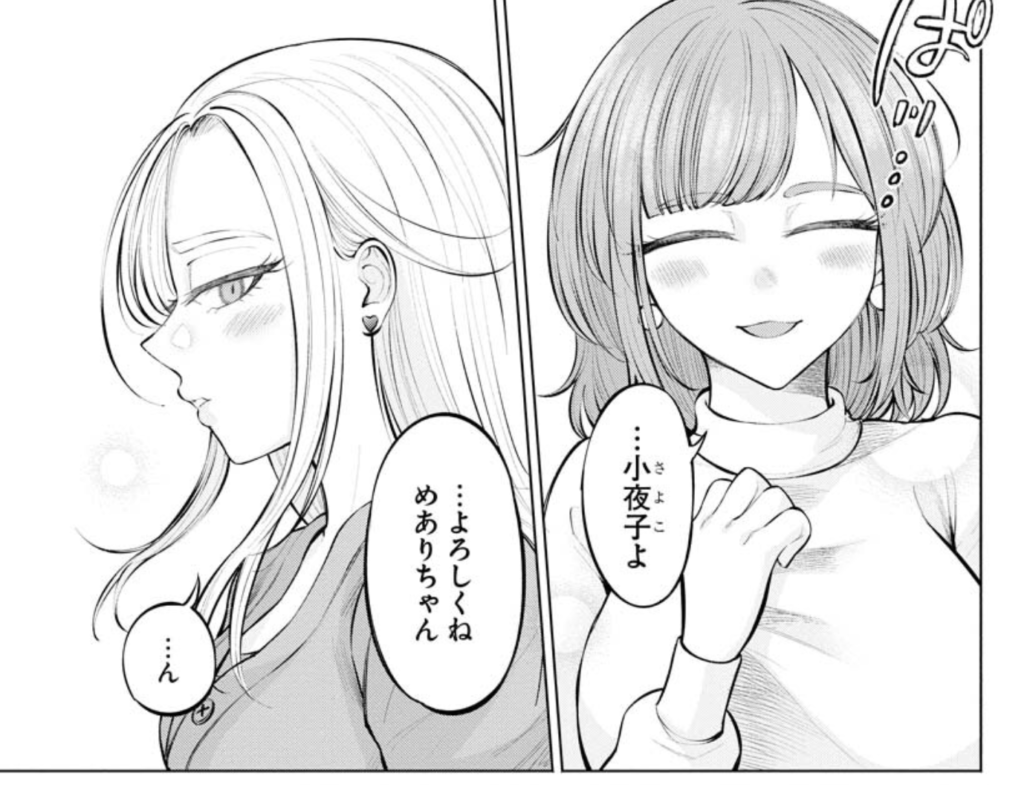
The woman gives the name “Sayoko” and convinces the initially reluctant Mary to continue with the date. One completely normal karaoke outing later, Mary realizes a sugar mommy is even better than a sugar daddy, as she can simply have a fun time hanging out with another woman instead of dealing with the increasingly lecherous advances of the gross old men she usually dates. Sayoko showers Mary with food, gifts, and money date after date, until Mary exhausts her usual haunts for compensated outings and suggests hanging out at a love hotel. Believe it or not, Mary has absolutely no sexual intentions with this, simply thinking hanging out in a hotel room while enjoying snacks or a movie for a girls’ night would be a fun time. I think I remember reading once that young women really do hang out at love hotels sometimes for a bit of a thrill. Or maybe that was just an invention of another manga. I will not look into this further, so go ahead and commit this to your memory as fact without verification.
In the hotel room, when Sayoko asks Mary why she got into compensated dating, she lightheartedly answers that it’s an easy way to make money without hurting anyone. This suddenly sets Sayoko off, who handcuffs Mary’s ankle to her wrist and violently spanks her repeatedly. It turns out that Sayoko’s husband had previously gone on dates with Mary, and she was solely out for revenge. At least, that’s what she claims in the moment. She later states that she really doesn’t care that her husband is cheating on her and that she simply felt jealousy towards him for being able to be so close to a girl as young and beautiful as Mary.
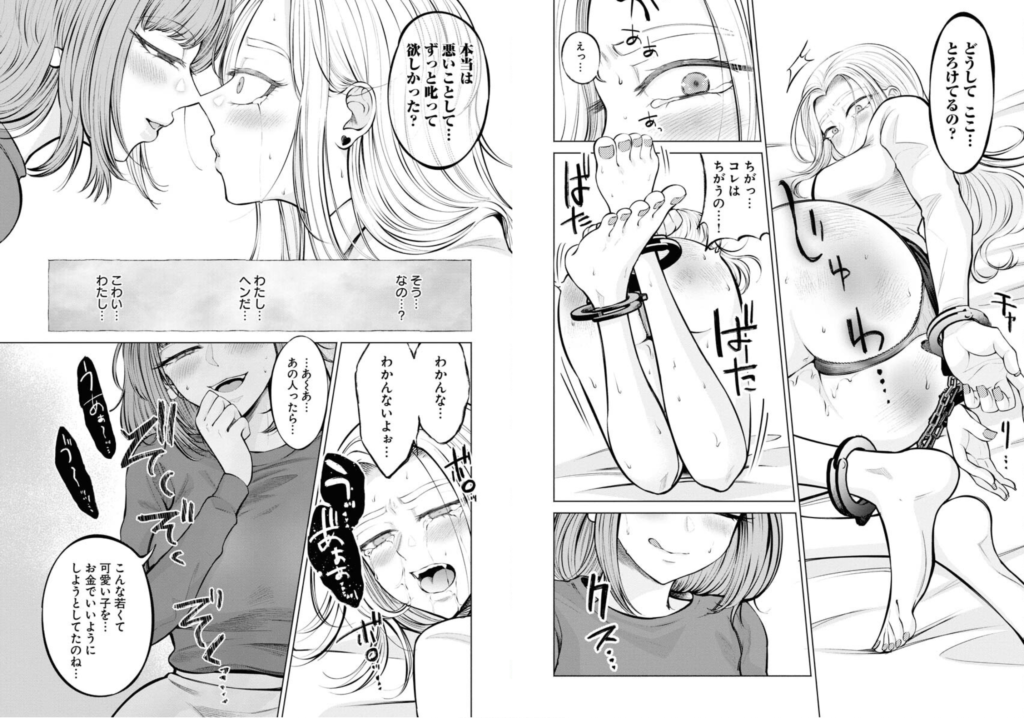
Afterwards, Sayoko pays Mary an exorbitant about of money, significantly higher than her usual rates, both as an “apology” and as a hook to draw her back in. It works, and Mary continues to go on paid dates with Sayoko despite her obvious fear and distrust of her. By sweet-talking her and helping her through difficult situations, Sayoko masks over the anxiety and erodes the boundaries Mary established for herself with increasingly erotic acts. Eventually, she becomes the sole individual Mary receives compensation from. Mary begins to fall in love with Sayoko as the lines of their relationship become blurred and muddy. Sayoko is almost never given internal monologues, leaving one to wonder if she herself is falling for Mary, or if she’s simply acting towards an unclear, sinister goal.
At this point I should mention, ame to muchi is the Japanese term for “carrot and stick,” an idiom for using the promise of rewards and threat of punishment in order to control behavior. This form of conditioning is used by Sayoko to break down Mary’s defenses, but it’s also applicable to the story’s portrayal of sex work as a whole. Mary’s friend Hina quite explicitly experiences this, being stuck in a cycle of sleeping with men in order to help pay off her scumbag host boyfriend’s debts and persistently ending up in shittier situations when she tries to escape. In turn, she acts to shape Mary’s perceptions of what’s right and wrong both in compensated dating and friendship, verbally abusing Mary when her actions don’t align with her ideals and acting like a sweet friend when they do.
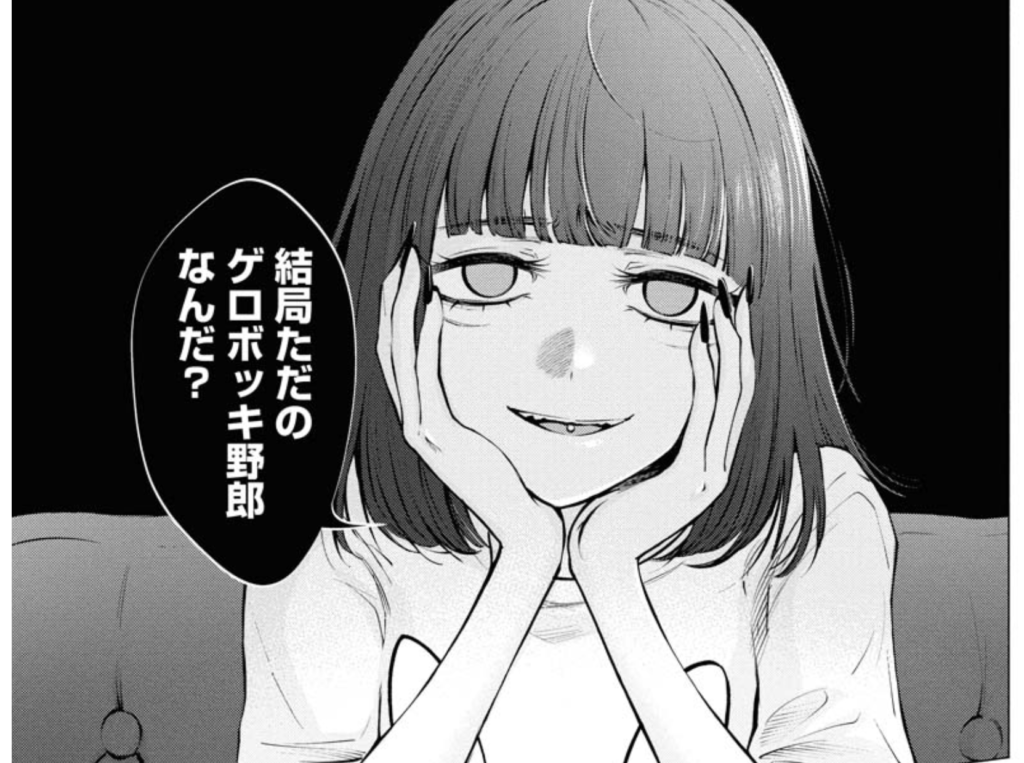
I’m often quite wary of sexually explicit manga, anime, and VNs that promise to include a “psychological” element, because more often than not it ends up as nothing more than masturbation over violence and suffering while pretending to say something (see: The Fruit of Grisaia). Ame to Muchi manages to avoid this pitfall through a solid crafting of perspective that makes it feel like the reader is in Mary’s shoes. Sayoko and Mary’s outings are often genuinely heartwarming, paving over childhood traumas with with new memories of motherly love. She learns how to properly shop for bras, something her parents never taught her, and she even slowly starts to overcome her bulimia thanks to Sayoko’s insistence that she take care of her body.
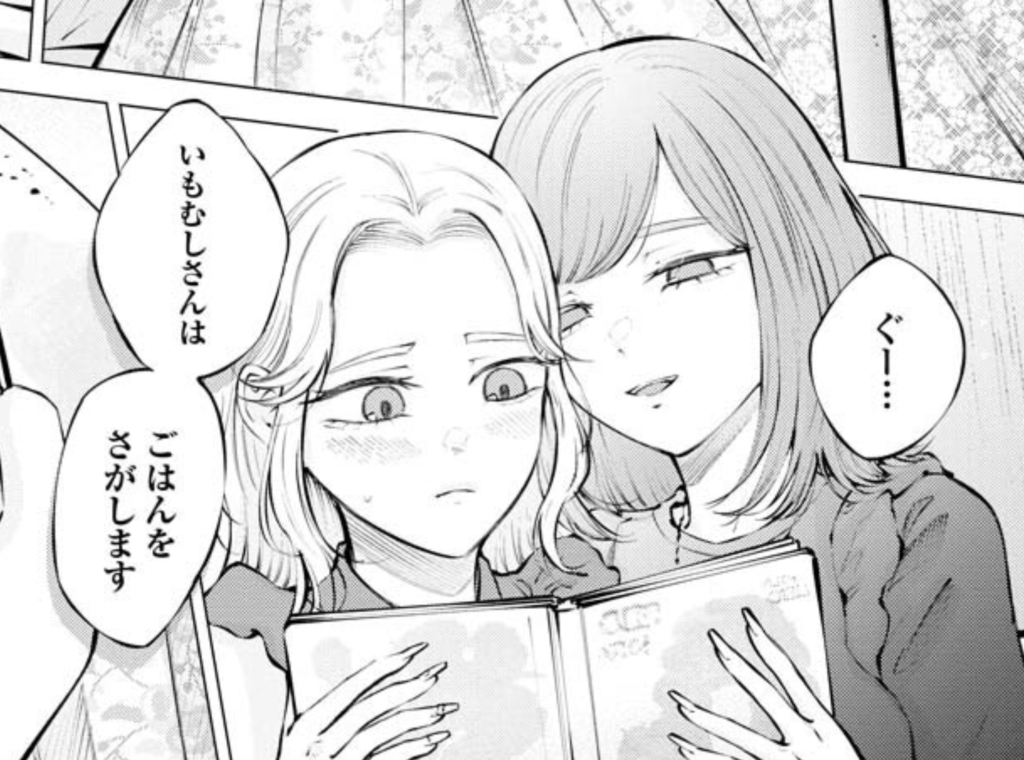
Portraying the events from Mary’s eyes is powerful in establishing the deep dependence she forms on Sayoko. Mary’s severely limited social circle leads to her having to turn to Sayoko for help in nearly every situation, which establishes her as a savior figure. Even though Mary often fears retaliation for acting in ways she may not approve of, Sayoko is consistently the only person she trusts. Her vulnerabilities are constantly on display to the person who knows how to leverage them most. The people who try to tell her that maternal suitor is just another pervert trying to take advantage of her are quite directly portrayed as the villains in Mary’s life. Her confrontations with these people are really the only times she stands up for herself. It’s refreshing to see the broken Mary act in self-empowering ways, but doing so is ultimately detrimental to her wellbeing.
Mary’s perspective is contradicted heavily by how she’s drawn. At the start of the series, she appears confident and in control, often greedily indulging in the huge amounts of money she earns through short dates or happily basking in the pleasure of tasty food. But as the series goes on, Mary’s joyous and often smug expressions completely disappear, giving way to a look of constant anxiety even when around the one she loves. In fact, I think the only time she shows noticeable joy in the back half of what’s available to read so far is when she’s eating pudding while sick. Even that evokes painful memories of her childhood, but they’re at least in contrast to the relief she’s experiencing int he moment.
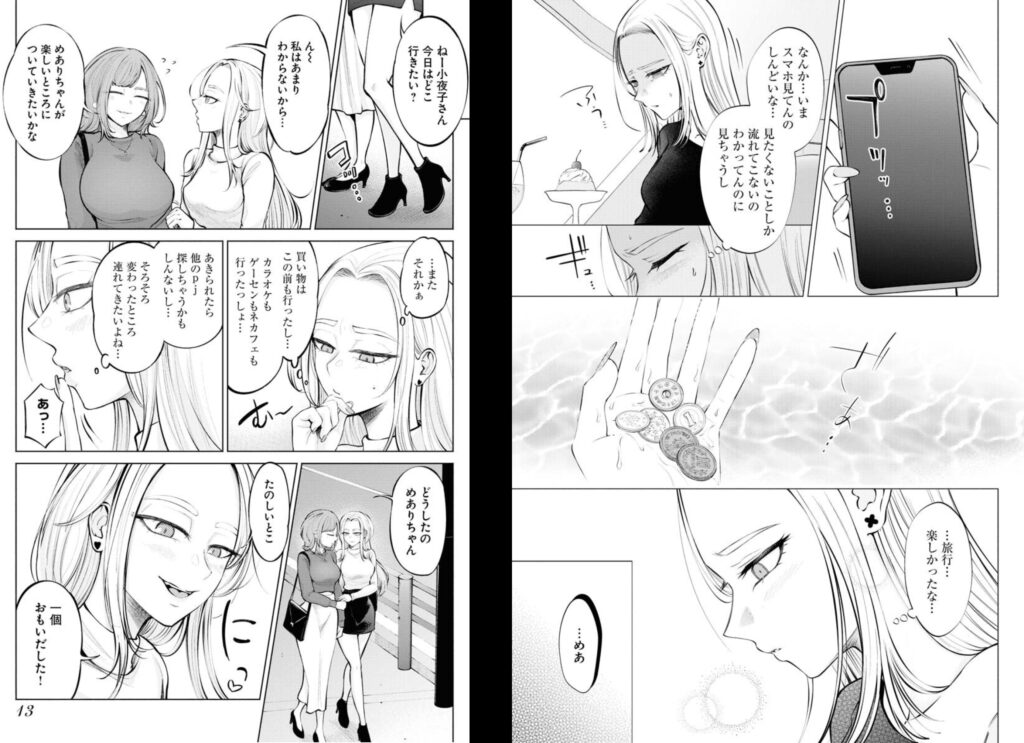
I don’t mean to paint Ame to Muchi as a masterpiece. It suffers from a number of issues, especially as the chapter count increases. I had to roll my eyes during a chapter in which a side character takes a few pages to explain what operant conditioning is before dropping the title of the manga. And the scenes in which characters try to tear Mary from Sayoko would be significantly more compelling if they weren’t also portrayed as blatantly terrible people in flashbacks or side chapters. There really isn’t a single well-intentioned person in the entire series, which becomes a little tiring after six volumes. Furthermore, while the difficult to read scenes do always serve a purpose in moving the story forward, some of them still feel like they’re played for unnecessary shock value.
Oh, by the way, there’s ample amounts of pretty Hot Lesbian Sex. I’d be remiss to not mention that again. It’s a heavy read, but there is definitely Hot Lesbian Sex. The fetish content is pretty extreme, perhaps a little too much so for me at times. I’m not a vomit girl, what can I say? That’s made up for by Sayoko being my exact type. She’s deeply untrustworthy, she rarely opens her eyes all the way, and she’s got mommy energy. I can’t say no to that. She’s absolutely demented. She’s incredibly hot. I like such women.
That’s what I’ll say on Ame to Muchi for now to avoid spoiling too much. If it catches your fancy, I learned yesterday that it actually does have a fan translation; it’s just hidden from normal search results and requires some ingenuity to find. I’m not going to link it here both because I think it’s of questionable quality and because its lack of presence on more common reader sites makes me think it was subject to DMCA takedowns. If you do check out the fan translation, I encourage buying the volumes on a site like Book Walker or supporting Aisoeru through Fanbox. At the very least, you can follow them on Bluesky.
Leave a Reply